Slow Plasma
Fast Plasma


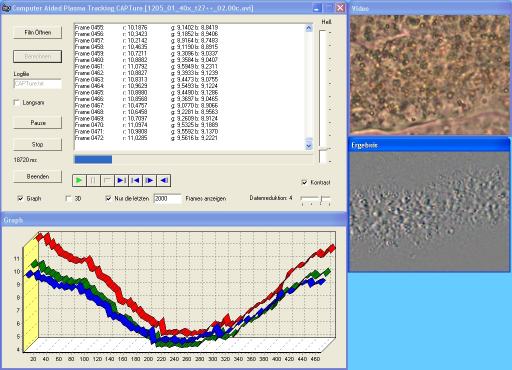
Then the captured video data is to be examined to get the velocity of the plasma you can see in the video. Several methods had been developed so far, but most of them require a complex arithmetic performance. The program used here analyses the protoplasmic streaming in another way, a so-called 'subtraction' method: Differences of two sequential, adjacent film pictures are determined. If the plasma did not move – between two successive pictures – or only very little, no or insignificant differences occur. If, on the other hand, a particle moved and is not any longer in its previous place, the alterations in the difference picture appear as white half-moons. The difference between successive pictures is calculated from the difference of corresponding pixels of the two frames.
|
Slow Plasma |
Fast Plasma |
|
|
|
The resolution capability of the measurements is at present still limited by the frame rate (25fps). The frames blur at high plasma speeds. That leads to a breakdown in the brightness of the 'subtraction' picture at the point of the maximum flow rate. With the help of further developed hardware equipment the problem of resolution loss at maximum velocity in the cytoplasmic streaming should be solved. However, the data acquired with the present system are quite suitable for a quantitative analysis of the cytoplasmic streaming. A real-time application of the CAPTure software reduces the amount of disc space needed and allows us to control the quality of the measurement during the experiment.
|
Program snapshot |
|
|
|
The four windows show the table of data points, the velocity graph, the original video frame and the computed 'velocity image'. On this image you recognize the flow better than in the original one. |