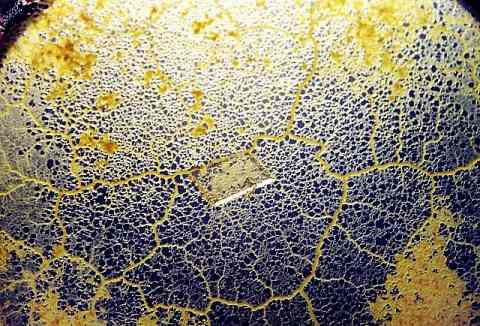
The scientific evaluation of fundamental relations in biology requires simple model organisms. Physarum polycephalum provides such a model system related to motility of the cytoskeleton by its cytoplasmic shuttle streaming. Within the past two years we developed a novel measuring device, based on a microchamber and digital image processing, that provides a basic understanding of the cytoplasmic streaming in the giant cell of the slime mold. We studied the effects of cytotoxic substances, specific inhibitors of the cytoskeleton, as well as temperature and UV-radiation on the model organism. Our results show that the slime mold is a remarkable model organism for the studying the influence of environmental impacts on the motility of a higher organized eucaryotic cell.
All experiments were performed with plasmodia of the slime mold Physarum polycephalum. The plasmodia were incubated in petri-dishes at 26°C under dark conditions in a self-constructed incubator. For all experiments plasmodia were cultivated on a half-synthetic medium according to Daniel& Baldwin (1964). By growing the plasmodia on a cellophane membrane the cells can easily be prepared for the experiments. In addition the cellophane membrane provides an optimum of light transmission for the microscopic measurements.
The experiments have been conducted in special micro chambers placed under the microscope. The chambers provide defined experimental conditions and in this way ensure the reproductivity of the measurements. Gaseous and liquid substances can be applicated to the cell without any disturbing mechanical effect. A temperature control provides automatically any temperature required between 10-45°C in the chambers with the help of three peltierelements. Fluids can either be evaporated on the peltierelements or indirectly applied to the cells by means of diffusion through a special cellophane membrane.
Video films of the Physarum cells have been produced with a CCD-camera (CS5260D, Tokyo Electronic Industry Co., Ltd) placed on a Zeiss Axiostar microscope at a magnification of 100x at a time resolution of 40ms. The video images were digitalized with a frame grabber card (Studio PCTV, Pinnacle Systems ) on a IBM compatible computer (1,7 GHz processor) and processed by the software CAPTure (Computer aided plasma tracking) which had been developed by us. This software provides exact data about the acceleration, periodicity and amount of cytoplasmic flow through the vessels of the slime mold.
We investigated the influence of temperature, UV-radiation, ethanol and specific inhibitors of the cytoskeleton components on the cells of Physarum polycephalum. Temperature gradients influence the duration of the shuttle streaming between two reversals. Temperatures at about 15°C or above 30°C led to longer streaming periods. The optimum of the velocity/duration ratio of the shuttle streaming could be measured at 26°C. Long term observations show that the slime mold changes from rather chaotic to more regular streaming patterns in the course of several hours. The rather unspecific toxic effect of ethanol on the cell turned out to be lethal up to concentrations of 85ppm and can be seen as a proof of the high sensitivity of the slime mold as a biotest. The effects of the myosin inhibitor 2,3-Buntanedione monoxime (BDM) and of the G-actin binding toxin Latrunculin A could be studied at concentrations up to 1 mM for BDM and 5 µM for Latrunculin A. Further ongoing experiments with specific inhibitors will lead to a better understanding about the role of the cytoskeleton responsible for the shuttle steaming in Physarum. The lethal effect of UV irradiation on the cells which we have observed have to be taken into account when using our method described above. Specific filters and light of defined wavelengths has to be used for further experiments.
In a nutshell the software ‘Computer aided plasma Tracking’ exceeds other techniques described before in precision and the amount of quantitative information about the shuttle streaming. Micro chamber and software have shown their capabilities during a number of experiments and are easily adaptable to other applications. The results provide conclusive proof for the ability of Physarum polycephalum functioning as a biotest.