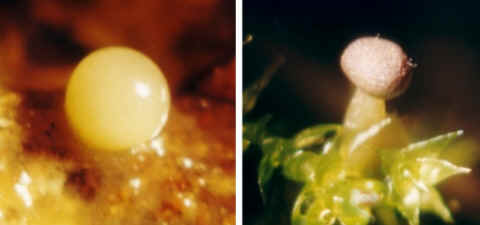
Slime molds (Myxomycetes) can be divided into two groups: The „real“ slime molds, Myxomycota and the cellular slime molds Acrasiomycota. The Acrasiomycota appear for most of their life cycle as single amoeboid cells, feeding on bacteria by phagocytosis. When the nutrients in a given microhabitat becomes depleted the single cells form to a pseudoplasmodium, a multicellular aggregate, that can differentiate into fruiting bodies.
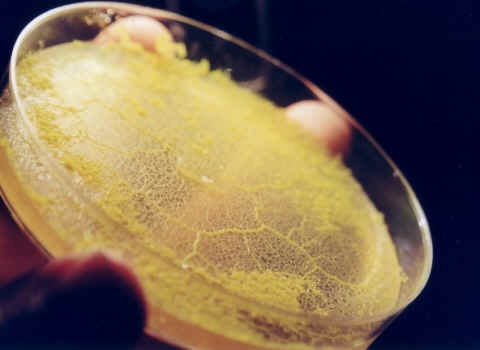
The Myxomycota establish large cell units without cell walls, so called plasmodia, consisting of a multinucleate protoplasma mass by fusion of haploid swarm cells. The plasmodium provides the vegetative phase of the slime mold. Plasmodia are able to live from solved nutrients or on bacteria, protozoa, or fungi, that are absorbed by phagocytosis (Sitte et al 1999). The real slime mold Physarum polycephalum, used, here, as model organism can be easily cultivated on axenic or synthetic media under defined laboratory conditions.
In the plasmodium of Physarum polycephalum a very fast cytoplasmic shuttle streaming from one end of the cytoplasm to the other can be observed, which changes it’s directions at an average of 20-50 seconds. Stress caused by light, temperature, a lack of nutrients and several other factors lead to the differentiation of the plasmodium into fruiting bodies.
The cytoplasmic streaming in Physarum polycephalum is the result of ATPase activity of actomyosin filaments, the altering concentrations between G- and F-actin and microtubules.
Besides the contractile motility, a gradual change in the viscosity of the cytoplasm is assumed, which is established by actin associated proteins and oscillating ion concentrations, causing the change in direction of the shuttle streaming every 20 to 50 seconds.
The cytoplasmic streaming is to a very high degree sensitive to environmental impacts. This fact makes the organism suitable as biosensor.